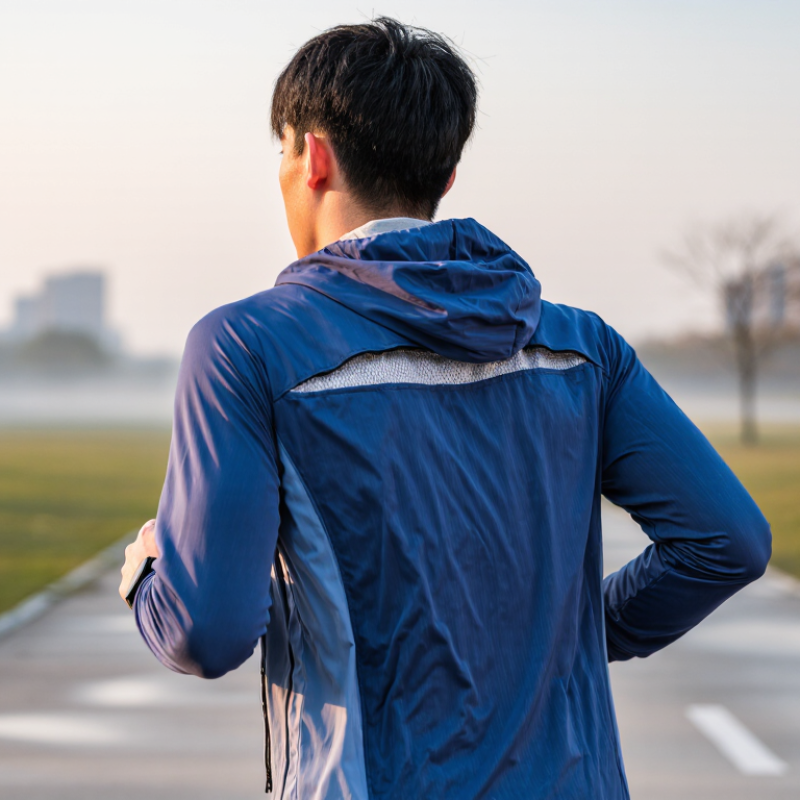
| 1. Create an escape route for warm air |
The opening allows warm, humid air trapped between the body and jacket to move outward. |
Exercise raises body temperature and increases humidity inside the garment. |
It reduces heat and humidity buildup across the upper back during sustained running. |
Position vents across the shoulder blades or upper back, where warm air commonly accumulates. |
| 2. Support sweat-vapor release |
A rear vent adds a direct opening beyond the jacket fabric’s moisture-transfer pathway. |
Sweat vapor can condense when humid air is held inside a poorly ventilated shell. |
Less internal condensation helps the next-to-skin layer feel drier for longer. |
Keep the vent unobstructed and pair the jacket with a lightweight moisture-wicking base layer. |
| 3. Use movement to increase airflow |
Arm swing and torso movement help pump air through the rear opening while running. |
A still air layer can become warm and saturated with moisture during high-output activity. |
Dynamic airflow improves ventilation without requiring a fully open front zipper. |
A loose but controlled vent flap can encourage airflow while limiting direct wind entry. |
| 4. Balance protection and breathability |
The jacket can remain more covered at the chest while releasing excess heat from the back. |
A completely open front may expose the runner to rain and cold wind. |
Rear ventilation offers cooling with less loss of front-facing weather protection. |
Use a covered or overlapping vent construction when rain resistance is important. |
| 5. Reduce fabric cling |
The opening relieves some trapped humidity and reduces the tendency of damp fabric to stay pressed against clothing. |
Wet inner layers can cling to the jacket and restrict comfortable movement. |
A small air gap can improve freedom of movement and reduce the clammy feeling. |
Choose a jacket with enough back ease for movement, but avoid an excessively loose fit that catches wind. |
| 6. Vent excess heat during high-intensity efforts |
The rear opening releases heat when pace, incline, or ambient temperature increases. |
Hard running produces more metabolic heat and sweat than easy running. |
It helps prevent overheating without requiring frequent stops to remove the jacket. |
Look for vents that can be opened or closed, especially for variable-speed training. |
| 7. Choose the right vent for conditions |
Vent size, placement, mesh backing, and flap coverage determine the balance between airflow and weather protection. |
Large open vents maximize airflow but may admit more rain or cold air than covered vents. |
Selecting the appropriate construction improves comfort across different temperatures and precipitation levels. |
Use open vents in mild, dry weather; covered vents in light rain; and adjustable vents in changing conditions. |
 CGE Clothing